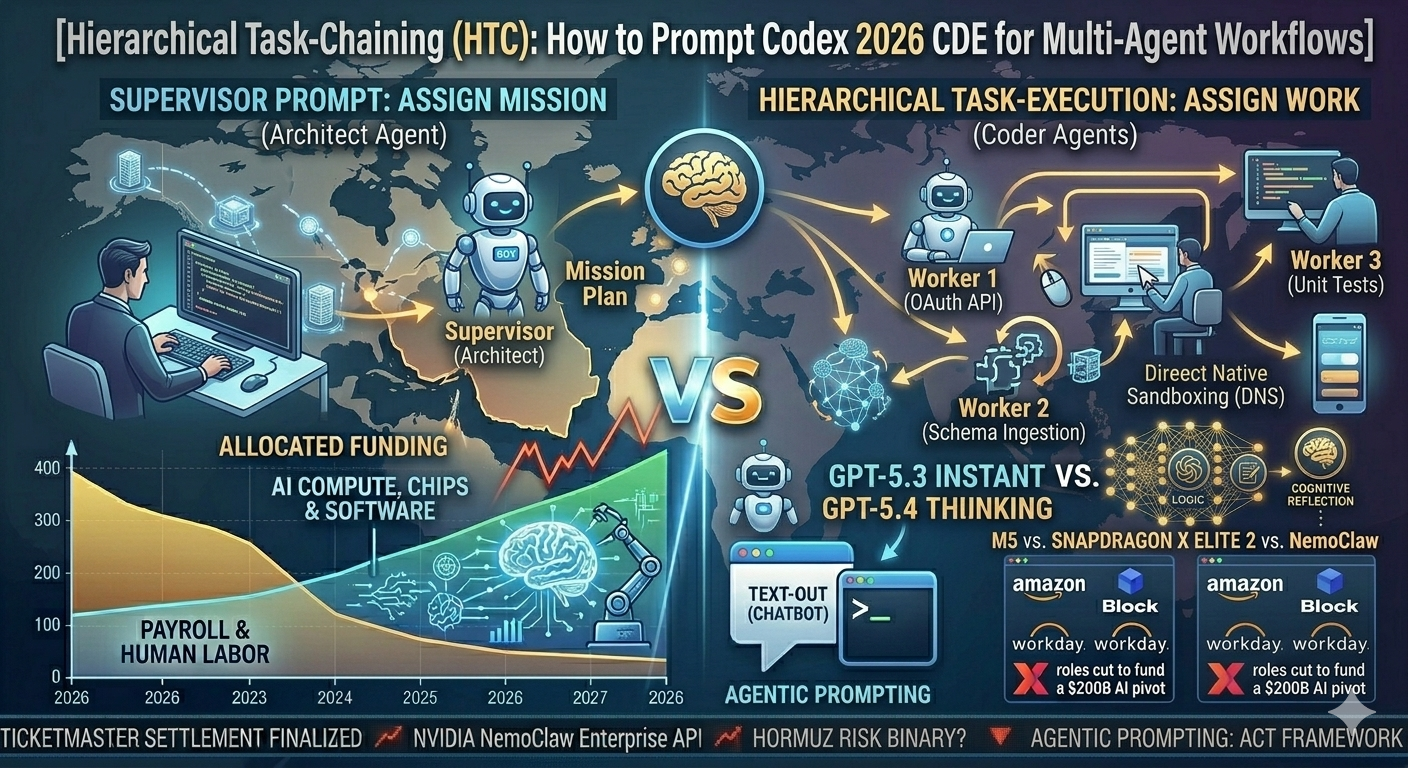
The standard prompt—”Write a function to…”—is dead for professional software development in 2026. With the release of the Codex CDE for Windows, developers now have access to Hierarchical Agent Systems (HAS).
The bottleneck is no longer the AI’s ability to code; it is the developer’s ability to architect a complex task. The solution is Hierarchical Task-Chaining (HTC).
Defining Hierarchical Task-Chaining (HTC)
Instead of interacting with one generalized AI model, HTC utilizes a structure where you, the human developer, manage a “Supervisor (Architect) Agent.” This architect does not write code. Instead, it analyzes the high-level goal, develops a plan, and then spawns and manages distinct “Worker (Coder) Agents” simultaneously.
The Step-by-Step Guide to HTC Prompting:
Step 1: The Supervisor (Architect) Prompt Do not ask for a solution. Assign a role and a mission.
Supervisor Prompt: “Act as the Lead Architect for the project at [Local File Path]. Our goal is to implement a new [OAuth 2.0 microservice] to replace the existing basic auth. Do not write code. Analyze the entire codebase. Create a comprehensive plan that identifies: 1. affected database schemas, 2. new API endpoints, 3. required libraries, and 4. potential security bottlenecks. When the plan is finalized, spawn separate worker agents for each sub-task.”
Step 2: Task Execution & DNS Sandboxing The Supervisor Agent now takes over. It spawns the Worker Agents. In Codex 2026, each worker agent automatically operates in an ephemeral Direct Native Sandbox (DNS), safely testing its localized code against a real environment.
Step 3: The Code Merge & Code Review Once the Worker Agents complete their tasks, the Supervisor Agent reviews their localized PRs, runs regression tests, and combines them into one stable submission for your final human review.
Why HTC is the Future of Coding
By moving to a Hierarchical Task-Chaining model, you are no longer limited by the context window of a single model. HTC allows for deep, recursive problem-solving that cloud-based chatbots simply cannot match. You are no longer just a coder; you are an AI orchestra conductor.
